
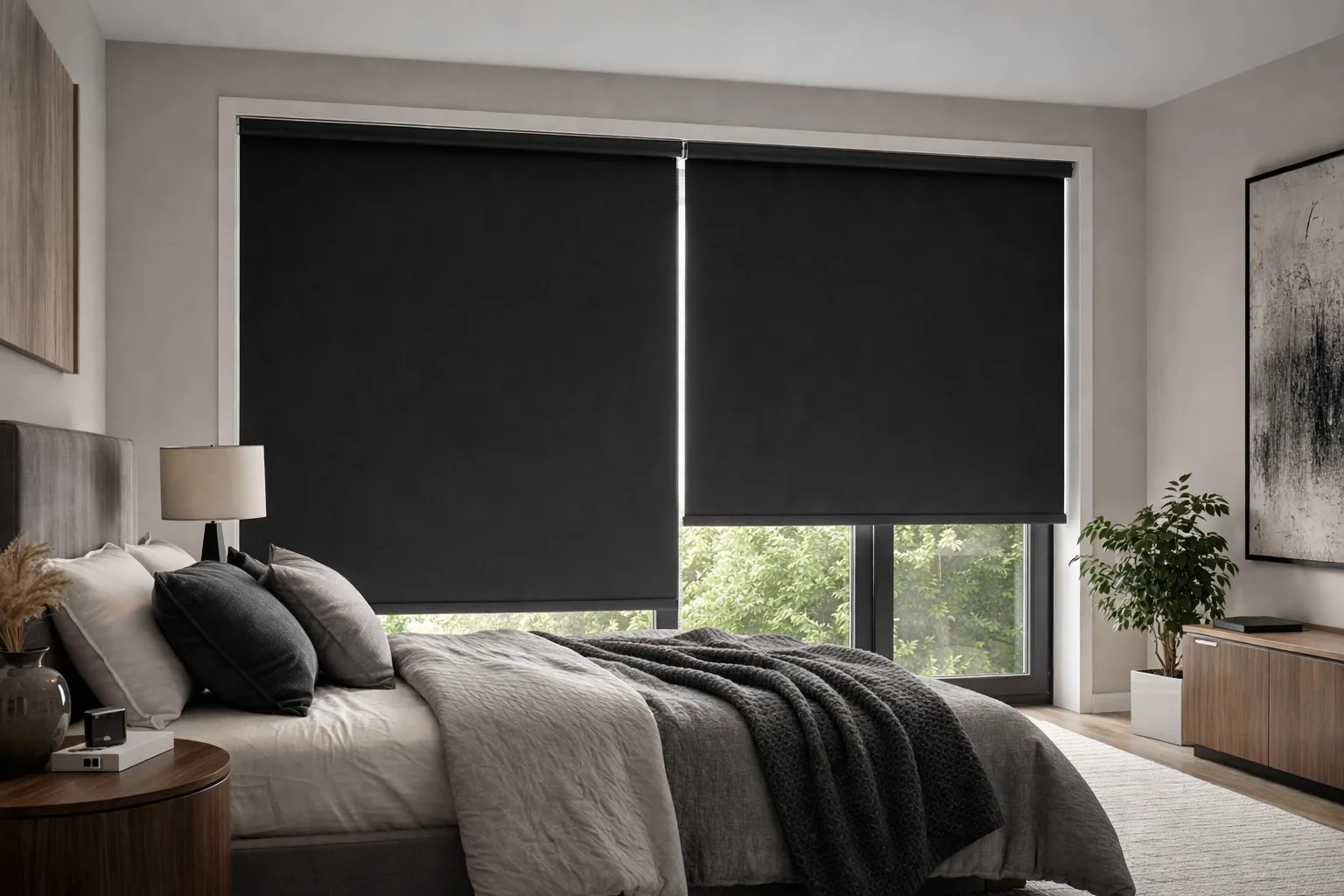

The main benefits of blackout blinds are deeper, more consistent sleep, full privacy day and night, a screen-friendly room with no washed-out picture, and some help keeping out summer heat. They’re clearly worth it in bedrooms, nurseries, media rooms and for anyone who sleeps during the day. In living rooms and kitchens they usually aren’t. How dark the room actually gets depends on three things: the fabric, the gaps around the edges and how the blind is mounted.
What Blackout Blinds Actually Do
A blackout blind uses a fabric that light can’t pass through: either a very dense weave or a fabric with an opaque coating or backing on the window side. Hold a good blackout fabric up to the sun and you see nothing through it, not even a glow. Compare that with a room darkening fabric, which is heavy and dim but still lets a faint glow through, and a light filtering fabric, which is designed to let softened daylight in.
That difference matters. “Dark enough” for a guest room is very different from dark enough for a baby’s afternoon nap in July or a night-shift worker sleeping at noon.
The Real Benefits of Blackout Blinds
1. Better sleep, especially outside normal hours
Light is one of the strongest signals your body uses to decide whether it’s time to be awake. Early summer sunrises, streetlights and a neighbour’s security light can all cut sleep short. A properly fitted blackout blind removes those cues, and it’s the benefit people notice first. For shift workers, new parents and anyone on an irregular schedule, it’s the clearest case for blackout over any other fabric.
2. Full privacy, day and night
Light filtering fabrics look private during the day, but at night, with lamps on inside, they can show silhouettes and movement. A blackout fabric doesn’t, which is why many homeowners choose it for ground-floor bedrooms, bathrooms and rooms that face the street or a close neighbour.
3. A proper room for screens
Daylight falling on a TV or projector screen washes out contrast and colour. In a media room or basement theatre that gets daytime use, blackout is close to a requirement. It also helps in a home office where a bright window behind or beside the monitor causes glare and eye strain, though there a lower-openness light filtering fabric is often enough.
4. Help with summer heat
Closing a blackout blind on a sunny afternoon stops direct sun from heating the room and fading floors and furniture. It helps, but blackout on its own isn’t the same as insulation. If temperature is the bigger problem, read our explanation of blackout vs. energy-efficient blinds before you choose.
5. A little noise dampening (with honest expectations)
Heavier blackout fabrics absorb a bit of sound and can soften echo in a room with hard floors. They won’t soundproof a bedroom on a busy road, though. If noise is the main complaint, the window itself matters far more than the blind.
Are Blackout Blinds Worth It? Room by Room
- Bedrooms: usually yes, especially east-facing rooms that get the early sun, and any bedroom used for daytime sleep.
- Nurseries and young kids’ rooms: almost always yes. Summer daylight lasts well past a young child’s bedtime in Ontario, and a dark room makes naps and bedtimes easier to keep consistent. Choose cordless operation for safety.
- Media rooms and basements with windows: yes, if the room is used during the day.
- West-facing bedrooms: yes, and it’s worth considering a blackout honeycomb shade that also handles the late-day heat.
- Guest rooms and home offices: a judgment call. A room darkening fabric or a zebra blind with a heavier fabric is often a better all-round fit.
- Living rooms, kitchens and dining rooms: rarely. You want daylight in these rooms, so the money is better spent on a good light filtering fabric or motorization.
If you’re torn between the two main fabric types, our blackout vs. light filtering comparison walks through the trade-offs.
What Actually Blocks the Light: Fabric, Side Gaps and Mount
This is where most disappointment with blackout blinds comes from. People buy a true blackout fabric, hang it, and still wake up to bright lines of light. The fabric is doing its job; the light is coming in around it.
The fabric
Check that the fabric is genuinely blackout, not “room darkening”. Colour matters less than people think with a proper blackout backing, but a light-coloured fabric without one will glow when the sun is on it.
The side gaps
An inside-mounted blind needs a small clearance on each side so the fabric can roll without rubbing the frame. That clearance is exactly where light gets in. On a roller blind, the fabric also sits slightly inside the width of the bracket, which adds to the gap. In most rooms nobody notices; in a bedroom at 5:30 am in June, you will.
The mount
- Outside mount: the blind is mounted on the wall or trim above the window and overlaps the frame on both sides. This is the simplest way to cut side light, and it’s our usual recommendation for bedrooms where darkness is the priority.
- Inside mount: looks cleaner and suits deep window frames, but always leaves thin light lines at the edges.
- Side channels: tracks along the sides of the frame that the fabric runs in. Ask about them for rooms that need near-total darkness with an inside look.
Don’t forget the top and bottom. Light over the roller can be reduced with a valance or cassette, and a bottom rail that sits flat on the sill closes the last gap. Accurate measuring makes all of this work; see our guide on how to measure for blinds.
Which Style of Blackout Blind to Choose
- Blackout roller blinds: the simplest, cleanest option and the easiest to pair with an outside mount or side channels. A good default for most bedrooms.
- Blackout honeycomb blinds: add an insulating air pocket, so they suit rooms that are too bright and too hot or cold.
- Zebra blinds with a blackout fabric: give you the day-night flexibility of a dual-layer blind, but some light passes at the band edges by design, so they’re room darkening rather than truly dark.
- Motorized blackout blinds: useful for hard-to-reach windows, and a schedule can open them gently at your wake-up time.
The Downsides Worth Knowing
Blackout blinds are an all-or-nothing tool: when they’re down, the room is dark, so you lose daylight and view. In a room used through the day, that means raising and lowering them more often. A dark room can also make it harder to wake up naturally, which is why some people pair blackout with a motorized schedule. And because the backing adds weight and stiffness, cheaper blackout fabrics can crease over years of use, so fabric quality matters more here than with light filtering fabrics.
Frequently Asked Questions
Do blackout blinds really block all light?
The fabric itself can block essentially all light, but the finished installation rarely does unless the edges are covered. Side gaps, the top of the roller and the bottom rail are where light gets in. An outside mount, side channels or a cassette get you close to full darkness.
What is the difference between blackout and room darkening blinds?
Blackout fabric stops light passing through the material. Room darkening fabric is dense and dims a room a lot, but a faint glow still comes through. Room darkening is fine for many bedrooms; blackout is the choice for daytime sleep, nurseries and media rooms.
Are blackout blinds good for bedrooms?
Yes, for most people they’re the best choice for bedrooms, especially rooms facing east or west and any room used for daytime sleep. For the best result, pair the blackout fabric with an outside mount so light doesn’t leak around the edges.
Do blackout blinds help keep a room cool?
They help, because closing them blocks direct sun on hot afternoons. For real insulation in both summer and winter, a blackout honeycomb shade does more than a single-layer blackout roller.
Are blackout blinds expensive?
They usually cost somewhat more than the equivalent light filtering fabric because of the backing or denser weave, but the difference is rarely dramatic. The bigger cost factors are the size of the window, the style of blind and options like motorization.
Get an Honest Recommendation for Your Rooms
You don’t need blackout on every window, and we won’t suggest it. Tell us how each room is used and which way the windows face, and we’ll recommend blackout only where it earns its place. We offer free in-home measurement and professional installation across Mississauga, Toronto and the GTA. Request your free quote and we’ll put together a room-by-room plan.