
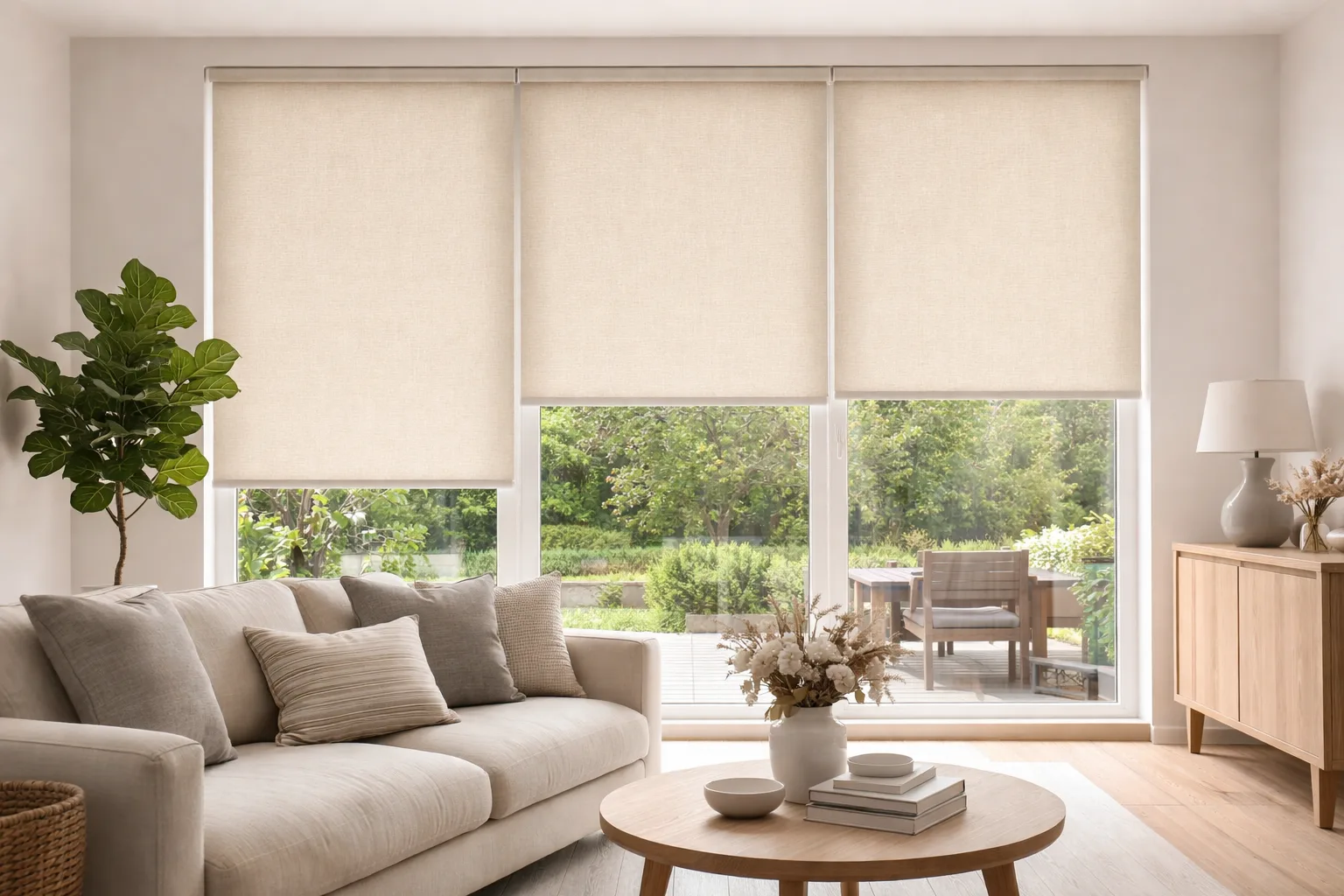

To choose roller blinds, start with what the room actually needs (privacy, glare control, darkness for sleep or just a clean look), then pick the fabric opacity, the colour, the mount and the way you’ll operate the blind, in that order. Roller blinds are simple by design, so these few decisions decide almost everything about how the blind looks and performs. Here is how we walk homeowners through it.
Quick Answer: How to Choose Roller Blinds
- Define the room’s job: light and privacy, glare control, or full darkness.
- Pick the opacity: sheer or screen, light filtering, or blackout.
- Choose a colour by looking at it against your own daylight, not under store lights.
- Decide on the mount: inside the frame for a neat look, outside for better coverage.
- Choose roll direction and top finish: standard or reverse roll, open roll or covered headrail.
- Pick the control: chain, cordless or motorized.
Step 1: Start With the Room’s Actual Problem
Before looking at colours, ask what the window is doing to the room right now. Is a neighbour looking in? Is the sun hitting the TV or your monitor at 4 pm? Do you need the bedroom dark at 5 am in June? Or is the window fine and you just want a finished look?
That answer narrows the fabric choice before aesthetics even enter the conversation, and it stops you from buying a beautiful blind that doesn’t fix anything. If different people in the house want different things from the same room, that is often a sign that a zebra blind, which adjusts between light and privacy, may suit better than a single-fabric roller.
Step 2: Choose the Right Opacity
Roller fabrics fall into three broad groups:
- Sheer and screen fabrics cut glare and keep a view outside. They give good daytime privacy but very little at night with the lights on.
- Light filtering fabrics soften daylight and block the view in, while still letting the room feel bright. They’re the usual choice for living rooms, kitchens and home offices.
- Blackout fabrics block light through the fabric itself. They’re for bedrooms, nurseries and media rooms.
One thing people don’t expect: a blackout fabric alone doesn’t guarantee a dark room. Light still comes around the edges, so the mount matters just as much (see Step 4). For the trade-offs in more detail, read our blackout vs. light filtering comparison.
Step 3: Understand Openness and Colour Together
Screen fabrics are often described by their openness, meaning how much of the weave is open. A more open weave lets in more light and more view; a tighter weave gives more privacy and glare control but a dimmer room.
Colour changes how that openness behaves. Darker fabrics absorb glare and usually give a clearer view out, while lighter fabrics bounce more light into the room but can look brighter and more “glowing” from the inside when the sun hits them. From the street, a lighter fabric also shows more of the room behind it at night.
For colour choice in general, warm greys, soft off-whites and taupes tend to age better than stark white, which can look clinical in some light. Always look at a sample at the actual window, at the time of day you use the room most. If your main goal is a bright living space, our guide to roller blinds for the living room goes deeper into keeping natural light.
Step 4: Inside Mount or Outside Mount?
An inside mount sits within the window frame. It looks tidy, shows off trim and keeps the wall clear, but it needs enough frame depth for the headrail and leaves a small gap at each side.
An outside mount fixes above the frame and overlaps it. It hides uneven or out-of-square frames, reduces light gaps at the edges, and can be mounted higher so the rolled-up fabric sits above the glass instead of blocking part of it. It’s usually the better choice for bedrooms that need darkness and for older homes with irregular frames.
Obstacles matter too: window cranks, handles, alarm sensors and deep sills can all decide the mount for you. If you plan to measure yourself, our guide to getting shade measurements right covers the common mistakes.
Step 5: Roll Direction and Headrail Finish
With a standard roll, the fabric drops from the back of the roller, closer to the glass. That keeps edge gaps smaller, which helps with privacy and darkness. With a reverse roll, the fabric drops from the front, away from the window. It hides the roller and clears handles or cranks that stick out from the frame.
The top of the blind can be left as an open roll or finished with a cover such as a cassette or valance that hides the roller and brackets. A covered headrail gives the most minimal look and is worth asking about where the top of the blind is at eye level, such as on a stairway window.
Step 6: Chain, Cordless or Motorized
- Chain control: simple, reliable and easy to use on large blinds. Choose which side the chain sits on based on furniture and the nearest wall.
- Cordless: you lift or lower the bottom bar by hand. It’s the safer choice in any room with children or pets and gives the cleanest look.
- Motorized: the right call for tall or hard-to-reach windows and for anyone who wants blinds on a schedule. They can be controlled by app, remote or voice, and wired, battery and solar-powered motor options are available.
Roller Blinds Room by Room
| Room | Typical fabric | Things to consider |
|---|---|---|
| Living room | Light filtering or screen | Glare on the TV, street-facing privacy at night |
| Bedroom | Blackout | Outside mount to limit edge light |
| Kitchen | Light filtering, wipeable | Moisture and cooking splashes; window behind the sink |
| Bathroom | Light filtering or blackout, moisture-tolerant | Night-time privacy, ventilation |
| Home office | Screen or light filtering | Screen glare without losing daylight |
| Kids’ room | Blackout | Cordless or motorized for safety |
When a Different Style Fits Better
Roller blinds are our default starting point, but they aren’t always the answer. For the best insulation on a drafty window, a honeycomb shade does more. For a wide sliding patio door, vertical blinds are often easier to live with. And if you want to adjust between light and privacy without raising the blind, a zebra blind gives you that range in one shade.
Frequently Asked Questions
What is the best roller blind fabric for a living room?
A light filtering or screen fabric suits most living rooms, because it keeps the room bright while cutting glare. Go slightly tighter or heavier if the window faces a close neighbour or a sidewalk.
Should roller blinds be lighter or darker than the walls?
Blinds close to the wall colour blend in and make a window feel calmer, while a contrasting colour makes it a feature. Darker fabrics also improve the view out on screen fabrics, while lighter ones reflect more daylight.
Can roller blinds be fully blackout?
The fabric can be, but light usually comes in around the sides and top. An outside mount that overlaps the frame, and a standard roll that keeps the fabric closer to the window, reduce those gaps noticeably.
Are roller blinds a good choice for a whole house?
Yes. Using the same system throughout, with different fabrics for different rooms, keeps a home looking consistent from outside and is often a sensible way to cover a new build all at once.
Talk It Through With Us
If you’d rather skip the decision tree, just tell us about the room. Browse our custom roller blinds in blackout and light filtering fabrics, then request your free quote. We’ll measure in person at no cost and recommend the right fabric and mount for each window.