
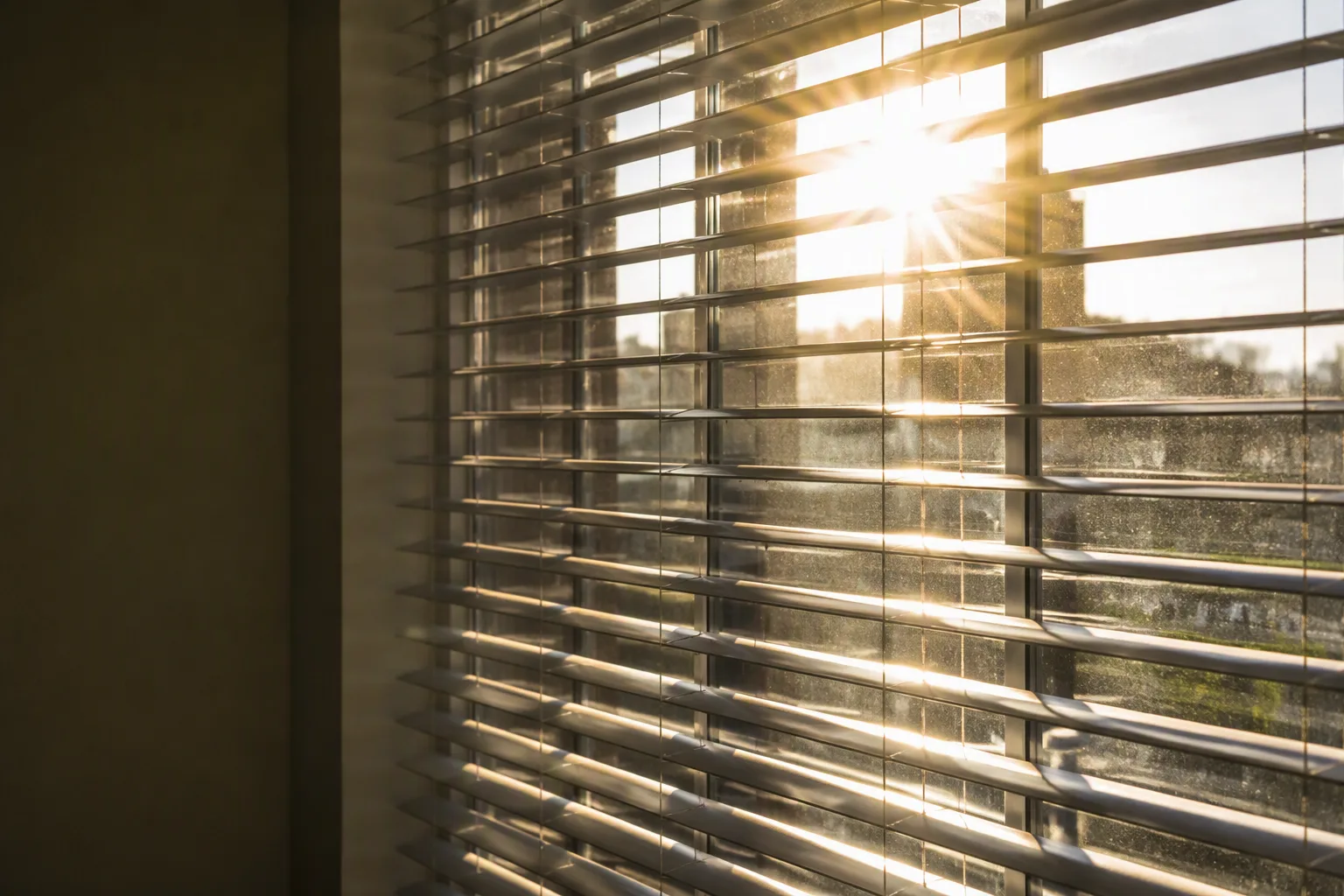

Light filtering blinds let in glare when the fabric is too open or too light in colour for the sun it faces, when light leaks around the edges of an undersized blind, or when the blind is left in one position while the sun moves. The blind usually isn’t faulty. The fix is typically a tighter or darker fabric for that one window, a mount that covers the edges, or a way to adjust the blind through the day. Here’s how to work out which one applies to you.
Quick Answer: How to Stop Glare Through Light Filtering Blinds
- Check when and where the glare happens. Low sun through the fabric points to the fabric; bright strips at the sides point to the fit.
- Choose a lower-openness fabric for windows that take direct low-angle sun.
- Go a shade darker. Darker fabrics absorb glare; very light ones can glow.
- Close the edge gaps with an outside mount or a correctly sized inside mount.
- Adjust through the day, manually or with a motorized schedule, or switch to an adjustable style like a zebra blind.
Why Light Filtering Blinds Don’t Stop All Glare
Light filtering fabric is designed to let light in, just scattered and softened. On most days that’s exactly what you want. But when strong, low sun hits the fabric directly, two things happen: some of it passes straight through the open spaces in the weave, and the fabric itself lights up. A bright, glowing panel at eye level is glare too, even if no direct sunbeam reaches you.
That’s why the same blind can feel perfect at noon and unbearable at 5 pm. In the GTA, west-facing rooms get this in late afternoon year-round, and south-facing rooms get it through the winter, when the sun stays low all day.
Fabric Openness Explained
Many light filtering and screen fabrics are described by their openness (sometimes called the openness factor): how much of the fabric is open space between the threads, usually expressed as a percentage. The rule is simple:
- More open fabric: more daylight, a clearer view out, less privacy and less glare control.
- Tighter (lower-openness) fabric: less direct light through the weave, better glare control and more daytime privacy, but a dimmer room and a hazier view.
Some light filtering fabrics aren’t described by openness at all, because they’re translucent solid fabrics rather than an open weave. These don’t give much view out, but they diffuse light evenly. With those, thickness and colour decide how much glare gets through.
Openness numbers aren’t always comparable between product lines, so the most reliable test is a sample held up at the actual window, at the time of day the glare bothers you.
Colour Matters as Much as Openness
Colour changes how openness behaves. A darker fabric absorbs more light, cuts glare better and actually gives a clearer view out through an open weave, because your eye isn’t dazzled by bright threads. A light fabric reflects more light back into the room, which is great for a dim space, but on a sunny window it can glow white and become the brightest thing in your line of sight.
If you love a light colour, choose a tighter weave on the windows that take direct sun and keep the lighter, more open fabric for the calmer ones. For more on balancing colour and opacity, see how to choose roller blinds.
Which Rooms Suit Which Openness?
| Room or window | Suggested openness | Why |
|---|---|---|
| Home office, any sunny exposure | Tight, darker colour | Screen glare is the main problem |
| Living room with a TV | Tight to medium | Cuts glare on the screen while keeping daylight |
| West- or south-facing living areas | Tight | Low sun in the afternoon or all winter |
| North- or east-facing living areas | Medium to more open | Softer light; keep brightness and view |
| Ground-floor rooms facing the street | Tight | More daytime privacy |
| Upper floors and rooms without close sightlines | More open | Privacy is less of a concern; maximize light |
| Kitchens and dining areas | Medium | Bright but comfortable; view to the yard |
| Bedrooms | Not openness-based | Blackout or room darkening instead |
If you’re unsure whether a room needs light filtering at all, our blackout vs. light filtering comparison covers that decision.
Glare Around the Edges: Mount and Fit
An inside-mounted blind needs a small clearance at each side so the fabric can move without rubbing the frame. On a roller blind, the fabric also sits slightly narrower than the bracket. That leaves thin gaps, and when the sun comes in at a steep side angle, those gaps become bright strips of direct light. They’re often seasonal: a gap you never noticed in June can hit you in the eyes in November.
Fixes, from simplest to most involved:
- Outside mount: the blind overlaps the frame on each side, which closes the edge gaps almost completely.
- Correct sizing: an inside mount made slightly too narrow leaves wider gaps than necessary. Accurate measurements matter; see our guide on how to measure for blinds.
- Standard roll instead of reverse roll: the fabric hangs closer to the glass, which narrows the side gaps.
The Sun Moves; a Fixed Blind Doesn’t
Some glare complaints aren’t about the fabric at all. A blind set for comfortable morning light may be wrong by late afternoon. You can adjust it by hand, of course, but in practice people don’t, so it stays half-down and glaring.
Two options help. Motorized blinds can run on schedules, and some systems support sunrise/sunset timing or light sensors, so the blind lowers when the afternoon sun arrives. Or choose a style that adjusts without moving the whole blind: a zebra blind shifts from soft filtered light to closed bands in seconds, which suits rooms where the glare comes and goes.
Screen Glare in Home Offices and TV Rooms
Screen glare is the most common reason people call a light filtering blind “not working”. Monitors and TVs wash out when a bright window sits behind or beside them. A tight, darker fabric usually solves it without losing the daylight; blackout is only needed in a dedicated media room. Moving the screen so it’s perpendicular to the window helps more than most people expect.
Frequently Asked Questions
Do light filtering blinds reduce glare?
Yes, they soften most daylight glare. They’re less effective against strong, low-angle sun, especially with a very open or light-coloured fabric. A tighter or darker fabric, or an adjustable style, handles those windows better.
What openness is best for glare?
For glare control, a lower openness (a tighter weave) combined with a darker colour works best. More open fabrics suit rooms where view and brightness matter more than glare, such as north-facing rooms.
Are dark or light blinds better for glare?
Dark blinds are better for glare, because they absorb light instead of glowing. Light colours bounce more daylight into the room, so they suit dim spaces rather than sunny, glare-prone windows.
Why do my blinds let light in at the sides?
Inside-mounted blinds need a small side clearance to operate, and roller fabric sits slightly narrower than its brackets. An outside mount that overlaps the frame is the simplest way to close those gaps.
Still Getting Glare? Let’s Look at the Window
If you’ve checked the fabric, the fit and the timing and the glare is still there, the right answer might be a different fabric or style for that one window rather than a whole-room change. Browse our light filtering roller blinds, then book a free in-home measurement: we’ll look at which way the window faces and when the glare hits, and recommend the openness, colour and mount to match. Request your free quote.
[…] more help, check our guide on light filtering blinds that block glare. Also, explore custom blinds for your budget and […]