
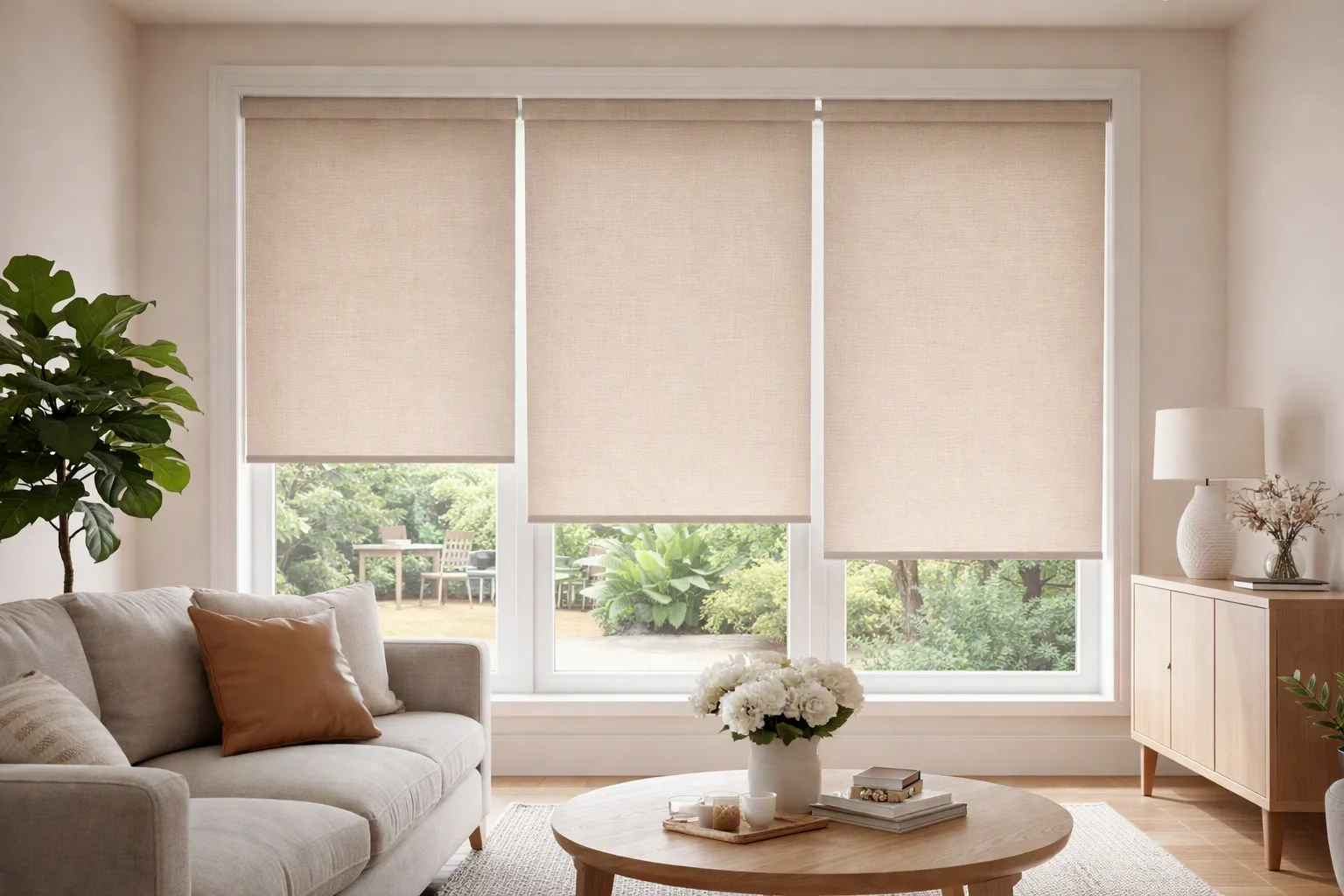

The best roller blinds for a living room that needs to stay bright are light filtering or screen fabrics in a light-to-mid tone, mounted high and wide enough that the rolled-up blind sits above the glass instead of in front of it. Fabric choice sets how much daylight comes through when the blind is down; the mount decides how much window you get back when it’s up. Get those two right, and the living room stays bright and private without the glare on the TV.
Quick Answer: Roller Blinds That Keep a Living Room Bright
- Choose light filtering or screen fabric, not blackout, for the main living space.
- Match openness to the view: a more open weave keeps the view out; a tighter one gives more privacy.
- Pick the fabric colour for the light you want: lighter tones bounce daylight around, darker tones cut glare and keep a clearer view.
- Mount above the frame when you can, so the roll clears the glass completely.
- Plan for night-time privacy separately, because light fabrics show more once the lights are on inside.
Why Blackout Fabric Is Usually Wrong for a Living Room
Blackout rollers are excellent in bedrooms and media rooms, but in a living room they force an all-or-nothing choice: blind up and full glare, or blind down and a dark room in the middle of the afternoon. Most people end up leaving them up, which defeats the point.
Light filtering fabric solves the everyday problem instead. It softens direct sun, blocks the view in during the day and still lets the room feel bright with the blind fully lowered. If the living room doubles as a movie room, that’s the one case where it’s worth thinking about a second layer or a different style, which we cover below.
Screen Fabric and Openness: Keeping the View
Screen (or solar) fabrics are woven with small open spaces, described as the fabric’s openness. The more open the weave, the more light and outside view come through; the tighter the weave, the more glare control and daytime privacy you get, and the dimmer the room.
For a living room that looks onto a backyard, trees or a skyline, a more open screen lets you keep the blinds down all day and still enjoy the view. For a front window that faces the street or a close neighbour, go a step tighter. A useful test is to hold a sample against the window at the time of day you actually use the room and look both ways: out to the view, and at how the light falls on the sofa and TV.
Fabric Colour Changes the Light More Than People Expect
Colour works in two directions at once:
- Lighter fabrics (whites, off-whites, pale greys) reflect more daylight into the room, so a lowered blind still reads as bright. The trade-off is that they glow a little when the sun hits them and the view through a screen fabric looks hazier.
- Darker fabrics (charcoal, bronze, deep grey) absorb glare and give the clearest view through a screen weave. The room feels a touch dimmer with the blind down, but eyes are more comfortable on a bright afternoon.
As a rule of thumb, a dim, north-facing living room benefits from a lighter tone, while a room with strong south or west sun and a view worth keeping often does better with a darker screen. Some fabrics have a lighter back facing the street and a different tone inside, which keeps the outside of the house looking uniform.
Mount It So the Blind Gets Out of the Way
This is the choice that decides how much light you get back when the blind is up. An inside-mounted roller sits within the frame, so the rolled fabric always hides a strip at the top of the glass. That looks tidy and shows off trim, but on smaller windows it costs you some daylight.
An outside mount placed a few inches above the frame lets the roll sit on the wall, clearing the glass entirely, and extending a little past each side reduces the light gaps when the blind is down. It also makes the window look taller. Where a clean inside mount is the goal, a slim covered headrail or cassette keeps the top neat. Our guide on how to choose roller blinds explains mounts, roll direction and headrail finishes in more detail.
Match the Fabric to the Window’s Direction
| Window faces | What the light does | Fabric that usually works |
|---|---|---|
| North | Soft, even light all day, rarely any glare | Light, sheer or very open screen; keep as much light as possible |
| East | Bright, low sun in the morning | Light filtering or medium screen |
| South | Strong sun most of the day, higher in summer | Screen fabric for glare and UV, colour chosen for view vs. brightness |
| West | Low, intense afternoon sun and heat, often across the TV | Tighter screen or heavier light filtering, often in a darker tone |
If a light filtering blind still leaves you squinting in the afternoon, the fix is usually openness, colour or edge gaps rather than a darker fabric. Our article on why light filtering blinds still let in glare walks through each cause.
Daytime Light vs. Night-Time Privacy
Here’s the part that catches people out. Screen and light filtering fabrics give good privacy during the day because it’s brighter outside than in. After dark, with the lamps on, the balance flips, and people outside can see shapes and movement through a light or open weave.
For a street-facing living room, there are three honest options: choose a slightly tighter light filtering fabric for that window only, layer drapery for the evening, or switch that window to a zebra blind, which moves between sheer and solid bands in one shade. Windows facing a private yard rarely need anything more than a good screen.
Several Windows in One Living Room
Open-concept living rooms often have windows on two or three walls, each getting sun at a different time. Two things help. First, keep the same fabric family across every window in one sightline so the room looks calm, even if openness varies slightly. Second, consider motorization for the set: motorized roller blinds can be grouped and put on schedules or sunrise and sunset timing, so the west windows lower themselves in the late afternoon while the others stay open. They can be controlled by app, remote or voice, with wired, battery or solar-powered motor options.
If the room still feels dim with the blinds up, the problem may be the room rather than the blinds. Pale walls, a light fabric and a mount that clears the glass completely help more than any single blind choice.
Frequently Asked Questions
What type of roller blind lets in the most natural light?
A sheer or open-weave screen fabric in a light colour lets the most daylight through while still cutting some glare. Light filtering fabrics come next and add more privacy. Blackout lets in almost none through the fabric itself.
Are roller blinds good for living rooms?
Yes. They’re simple to use, take up very little space when raised, and come in fabrics from sheer to blackout, which makes them easy to match to the light in each room. For street-facing windows, plan for night-time privacy as well.
Can people see through light filtering roller blinds at night?
They usually can’t see detail, but with lights on inside they may see shapes and movement, especially through lighter or more open fabrics. A tighter fabric, a layer of drapery or a zebra blind gives more privacy after dark.
What colour roller blind is best for a living room?
Lighter tones keep a room bright and suit north-facing or smaller windows. Darker tones cut glare and give a clearer view out, which suits strong south or west sun. Always check a sample at your own window before deciding.
Want a Second Opinion on Your Living Room Windows?
Every living room gets light differently, so the best fabric is the one tested against your own windows. Browse our custom roller blinds in light filtering and blackout fabrics, then request your free quote. We’ll measure in your home at no cost and recommend the fabric, openness and mount for each window, across Mississauga, Toronto and the rest of the GTA.