
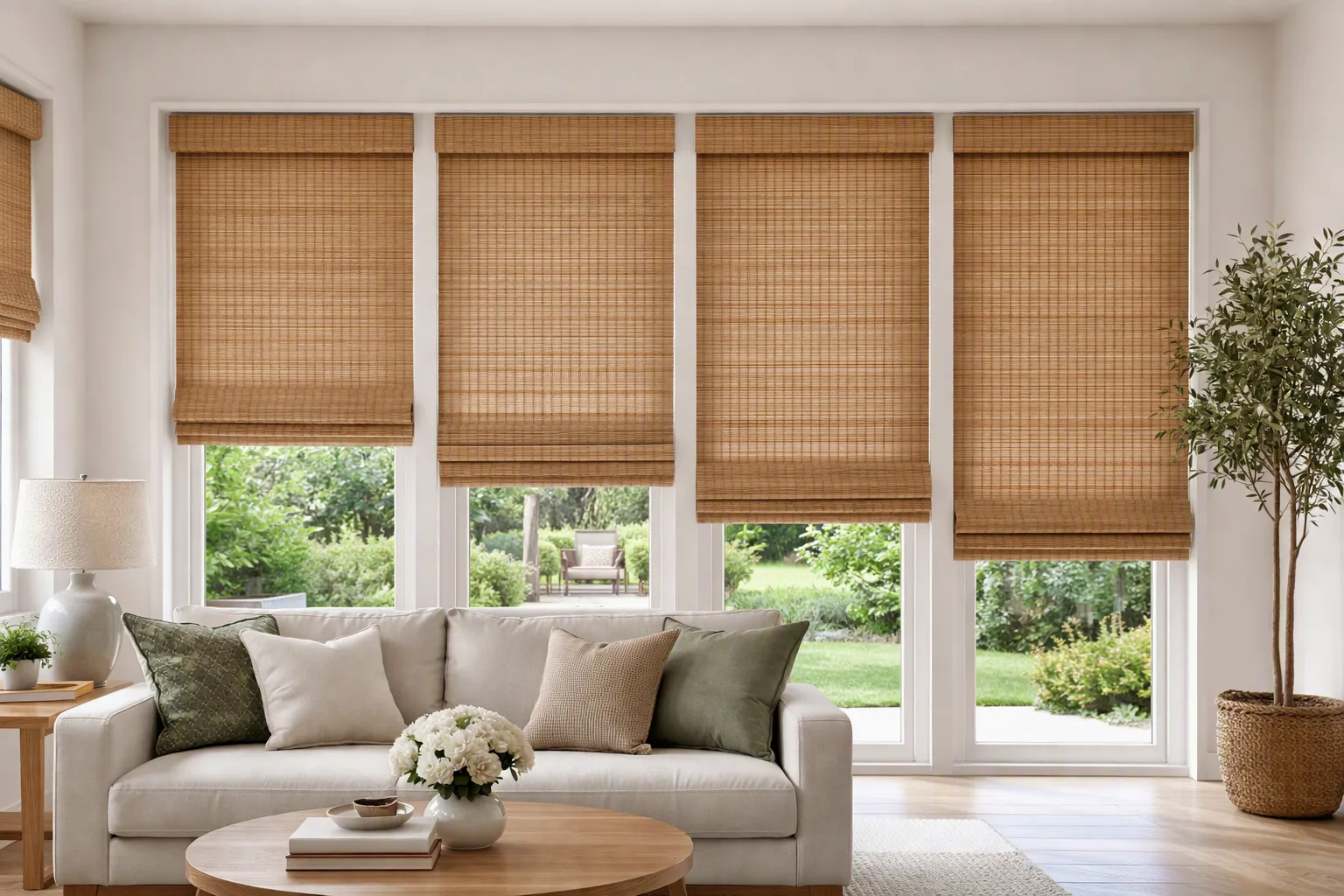

The best blinds for arched windows are shades made to the exact curve of the arch, most often a fixed honeycomb (cellular) shade that fans out to follow the shape. Standard rectangular blinds can’t bend to fit a curve, so your real choices are a custom arch shade, covering only the rectangular part below the arch, or leaving the arch open for light. Bay windows and other odd shapes follow the same rule: measure each piece of glass carefully and choose a product that suits the shape rather than forcing a standard size to fit.
Can You Put Blinds on an Arched Window?
Yes, but only with a product designed for curved openings. Horizontal slats and roller blinds are rectangular by nature; they can’t follow a curve. What works is a shade built to a template of your arch, so it sits neatly in the frame without gaps.
Before choosing a product, decide what you actually need from the arch. That decision affects both cost and complexity more than anything else.
- Privacy and light control: bedrooms and bathrooms, or arches facing a neighbour
- Glare and heat: sun-facing arches that make a room hot or wash out a TV
- Nothing at all: high arches on a staircase or above a living room window are often best left uncovered as a feature
Your Main Options for Arched Windows
Fixed arch shades
A fixed arch shade is made to the exact curve and stays in place. Honeycomb-style fabric is the most common choice because its pleats spread out like a fan, giving a clean, built-in look. Because the shade doesn’t open, it works best on arches above a separate lower window, where you rarely need to change the light.
Covering only the rectangle below
Many arched windows are really a rectangular window with a half-round or “eyebrow” transom on top. In that case, the simplest approach is a regular made-to-measure blind on the rectangular part and nothing (or a fixed shade) on the arch. You keep daylight coming through the top and full control where you need it.
A blind mounted above the arch
If the arch is a single opening and you need it fully covered and fully open at different times, an outside-mounted blind installed above the highest point of the curve can cover the whole window. It hides the arch shape when lowered, so it suits rooms where function matters more than showing off the architecture.
Blinds for Bay and Bow Windows
A bay window is usually three windows set at angles; a bow window is four or more that form a gentle curve. The challenge isn’t the shape of each window, which is often a plain rectangle. It’s what happens where they meet.
- Measure each window separately. Panes that look identical often differ slightly, especially in older homes.
- Plan the corners. Blinds need to close cleanly at the angled joints without the headrails colliding or leaving a bright gap.
- Check the mount depth. Bays often have shallow frames or a deep sill, which decides whether an inside or outside mount works.
- Keep the look consistent. Matching fabric and bottom-rail height across all panes makes the bay read as one feature.
Roller blinds and zebra blinds are popular in bays because each pane can be controlled independently while the fabric looks continuous. Honeycomb shades are a good fit for bay windows that lose heat, since the cells add an insulating layer on each pane.
Other Oddly Shaped Windows
Angled and trapezoid windows
Slanted-top windows are common under sloped ceilings, in lofts and in some newer homes with vaulted great rooms. Like arches, they usually need a fixed shade made to the angle, or a blind on the rectangular section below with the angled part left open.
Extra-tall or extra-narrow windows
Tall, narrow windows show up often in newer townhomes and infill houses. A standard size may technically fit, but the proportions can look stretched. Made-to-measure roller or zebra blinds keep the proportions right, and for windows you can’t comfortably reach, a motorized blind saves climbing on furniture.
Circles, octagons and small accent windows
Small round or octagonal windows are usually decorative. Most homeowners leave them open; if one lets in harsh morning sun or faces a neighbour, a fixed shade cut to the shape is the tidy solution.
Large windows and sliding doors
Very wide openings aren’t “odd” in shape, but they have their own needs: sturdy hardware, smooth operation and a way to move a lot of fabric. For patio doors and wide spans, vertical blinds are a practical choice.
Why Toronto Homes Have So Many Unusual Windows
Toronto has a mix of housing from very different eras, and each brings its own window quirks. Older Victorian and Edwardian houses often have arched transoms, stained-glass accents and frames that have shifted slightly out of square over the years. Postwar bungalows frequently have a front bay. Newer infill homes and townhouses lean toward tall, narrow windows and large panes.
The common thread is that off-the-shelf blinds rarely fit these well. For a broader look at how we approach different home types across the city, see our guide to custom blinds across Toronto.
How We Measure Arched and Unusual Windows
For any unusual window, measuring once isn’t enough. We measure at several points across the width and height, check whether the frame is square and note the mount depth. For arches and angles, we record the geometry precisely, and sometimes make a template or on-site sketch, so the shade is made to the real shape rather than a guess.
This is also where we’ll tell you honestly if a window is better left uncovered, or if covering part of it gives you what you need for less.
Frequently Asked Questions
What type of blind is best for an arched window?
A fixed honeycomb-style arch shade is usually the best fit because it follows the curve and adds insulation. If the arch sits above a rectangular window, a regular blind on the lower part with the arch left open is often the simplest and most practical choice.
Can arched window blinds open and close?
Most shades made to fit an arch are fixed, meaning they stay in place. If you need to open and close the whole window, an outside-mounted blind above the arch is an option, although it covers the curved shape when lowered.
Should I cover the arch or leave it open?
Leave it open if it’s high up and doesn’t cause glare, heat or privacy problems; it brings in daylight and shows off the architecture. Cover it if it faces a neighbour, lights up a bedroom early or makes a room too hot.
Do bay windows need one blind or several?
Almost always one blind per pane. Separate blinds close cleanly at the angles, let you control each side independently and avoid the gaps a single wide blind would leave.
Have an Unusual Window? Let’s Take a Look
If you’ve been putting off an arched, angled or bay window because it seemed complicated, it usually isn’t once it’s measured properly. We offer free in-home measurement across Toronto, Mississauga and the GTA, with professional installation. Request a free quote and mention the shape of the window; we’ll recommend what makes sense and what doesn’t.