
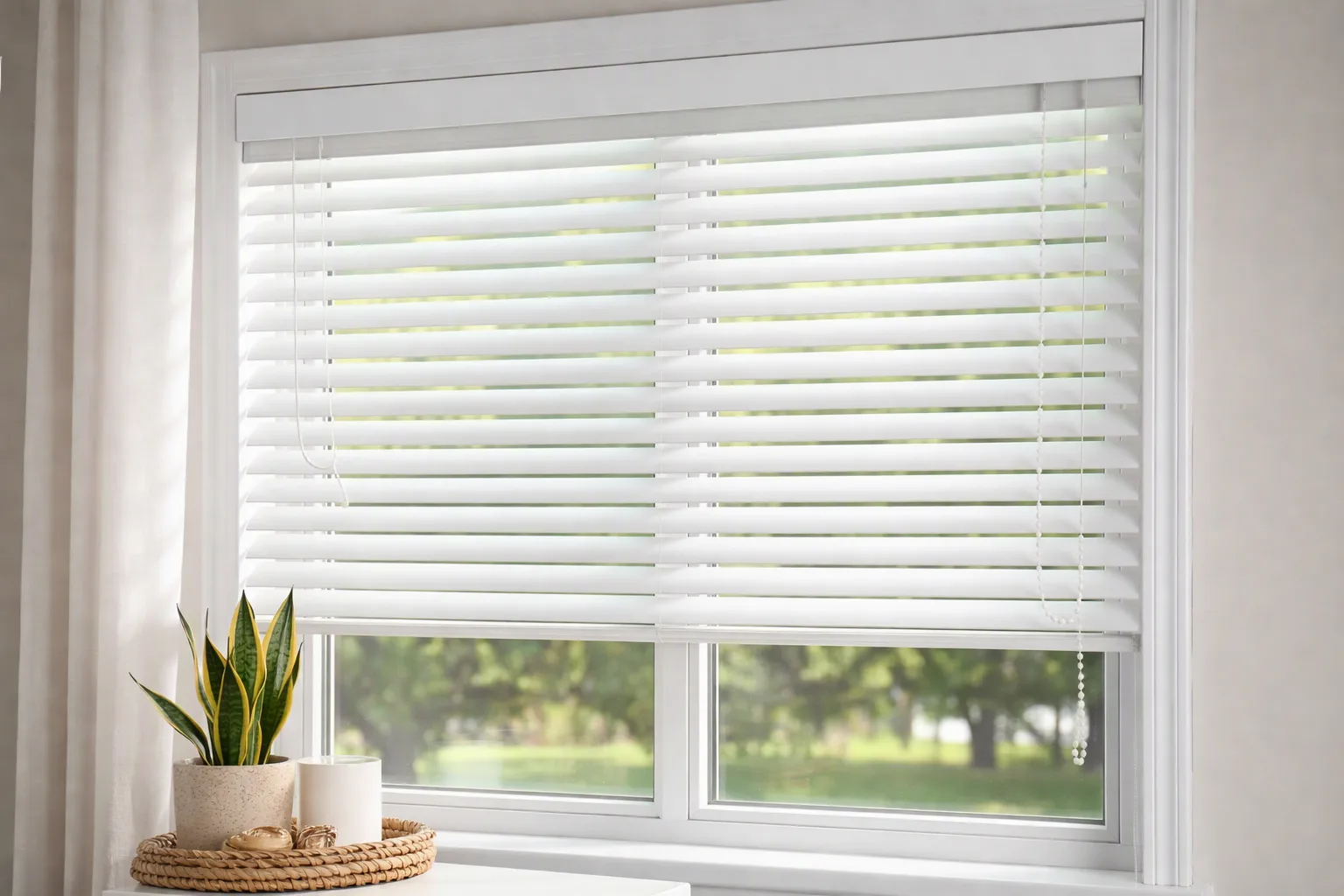

Most vinyl blinds problems come down to a handful of causes: a tilt mechanism that has slipped or worn out, a cord lock that is jammed or engaged at the wrong angle, lift cords that have become uneven, or slats that have warped from heat or snapped from wear. Horizontal slat blinds, whether vinyl (PVC), aluminum or wood, are mechanically simple, so many of these can be fixed in a few minutes without tools. Others, especially warping and repeated mechanism failures, are a sign the blind is at the end of its life.
Quick Answer: Common Vinyl Blind Problems and Fixes
- Slats won’t tilt: reconnect the wand, re-seat the tilt cord or clear debris from the tilter; replace the tilter if it spins freely.
- Blind won’t come down: pull the lift cords toward the centre of the blind to release the cord lock, then lower gently.
- Blind won’t stay up: pull the cords sideways toward the outer edge to lock them; clean or replace a worn cord lock.
- Blind hangs crooked: lower it fully, even out the lift cords and check for knots or tangles.
- Frayed or broken cord: restring the blind with new cord.
- Warped or broken slats: replace individual slats if you have matching spares; widespread warping means replacing the blind.
Slats Won’t Tilt (or Tilt Unevenly)
Tilting is handled by a small gear, called the tilter, inside the headrail. It turns a rod that runs the length of the headrail, and that rod rotates drums that hold the ladder strings supporting each slat. When tilt fails, work through it in this order:
- Check the wand. A tilt wand that’s popped off its hook turns without doing anything. Clip it back on.
- Tilt fully both ways. Turning the wand fully closed and then fully open sometimes re-seats a gear that slipped.
- Look for debris. With the blind down, dust and grit can clog the tilter. A little compressed air into the headrail often frees it.
- Check the drums. If one side tilts and the other lags, the ladder string on that side may have slipped off its drum, or the drum has cracked.
If the wand spins freely with no resistance at all, the tilter’s gears are stripped. Replacement tilters exist, but matching the right one to an older headrail is hit-and-miss, and on a budget vinyl blind the repair often isn’t worth the effort.
Blinds Won’t Go Up or Down
The cord lock is the little mechanism at the end of the headrail where the lift cords exit. It grips the cords when you pull them sideways and releases them when they hang straight or angled toward the centre.
- Won’t come down: pull the cords slightly toward the middle of the blind and then let them slide. Tugging straight down or outward keeps the lock engaged.
- Won’t go up: the cords may be knotted or twisted inside the headrail, or the blind is so uneven that one side has jammed. Lower it completely and straighten the cords before trying again.
- Won’t stay up: the teeth in the cord lock are worn or full of dust. Lower the blind, look into the lock, clear any lint with a small brush and try again. A lock that still slips needs replacing.
Blind Hangs Crooked or Raises Unevenly
A blind that lifts faster on one side almost always has lift cords of different effective lengths. That happens when the blind is raised from one cord more than the other, or when a cord has been retied. To fix it, lower the blind fully so the bottom rail sits level, lock the cords, and check whether one cord hangs longer than the other at the pull end. Even them up and knot or clip them together. Also check for a cord that has slipped off a pulley inside the headrail or tangled around the tilt rod.
If the headrail itself looks tilted, the problem is the brackets, not the blind: one may be loose, bent or mounted slightly out of level.
Frayed or Broken Lift Cords
Cords wear where they pass through the headrail and the slats, and a frayed cord eventually snaps, leaving the blind stuck or dropping on one side. Restringing is a fiddly but manageable job: take the blind down, lay it flat, remove the plugs under the bottom rail, join the new cord to the old one and pull it through, then tie it off at the bottom. Canada has strict rules for corded window coverings, so if you restring, keep loose cord lengths short and use a cord cleat or tension device out of reach of children and pets. Older blinds with long, looped cords are worth replacing for safety alone.
Warped or Bent Vinyl Slats
Vinyl softens with heat. On south- or west-facing windows, especially where the blind sits close to the glass through Ontario summers, slats can sag, bow or curl, and they may also yellow with sun exposure. Unfortunately, warping is generally not reversible; slats that have bent from heat don’t reliably straighten again.
If only one or two slats are bent from a knock rather than heat, replace them (see below). If the whole blind is bowing, that window is simply too hot for vinyl, and putting up another vinyl blind will likely end the same way. Aluminum slats or a fabric shade hold up better on hot windows.
Broken or Cracked Slats
Individual slats can be swapped out. Lay the blind flat, remove the plugs under the bottom rail, untie the lift cords and slide them up past the broken slat, pull it out of the ladder string, slide in the new one, then re-thread and re-tie the cords. If you have no spare, you can borrow one from the bottom of the blind, which works as long as the blind is a little longer than the window needs. Replacement slats from a different batch often won’t match a blind that has faded, so check the colour before you start.
When It’s Time to Replace Instead of Repair
Replacing a slat blind usually makes more sense than repairing it when:
- Several slats are warped or discoloured, not just one or two.
- The tilt or lift mechanism has failed more than once.
- The blind has long, looped cords that don’t meet current safety expectations.
- You’re constantly cleaning dusty slats and would rather have something easier to live with.
At that point it’s worth asking whether another slat blind is really the right product for the window. A roller blind has no slats to warp, crack or collect dust, and it’s available cordless or motorized. A zebra blind gives you the same “tilt-like” control between light and privacy, using sliding fabric bands instead of slats. If you’re comparing budget options, our look at where affordable vinyl and aluminum blinds actually hold up is a useful next read, and how to choose roller blinds covers fabrics and mounts.
Frequently Asked Questions
Why won’t my vinyl blinds tilt?
Usually the tilt wand has detached, the tilter gear has slipped or clogged with dust, or a ladder string has come off its drum. If the wand spins with no resistance, the tilter is stripped and needs replacing.
Why won’t my blinds go down?
The cord lock is still engaged. Pull the cords toward the centre of the blind to release it, then let them slide gently. If they still won’t move, check for a knot or tangle at the headrail.
Can you fix warped vinyl blinds?
Generally not. Heat-warped vinyl slats rarely straighten reliably. Replace a single bent slat if you have a spare; if the whole blind is bowing, replace it with a material better suited to a hot window.
How long do vinyl blinds last?
It depends heavily on sun exposure and use. Vinyl blinds on cool, north-facing windows can last a long time, while those on hot south- or west-facing windows tend to warp and discolour much sooner.
Are vinyl blinds worth repairing?
Simple fixes like a detached wand, a jammed cord lock or uneven cords are worth doing. Repeated mechanical failures or widespread warping usually mean replacement is the better use of your money.
Ready for Something That Lasts?
If your slat blinds keep giving you trouble, we can help you choose a replacement that suits the window, whether that’s a light filtering roller, a zebra blind or a cordless option for a child’s room. We offer free in-home measurement and professional installation across Mississauga, Toronto and the GTA. Request your free quote.