
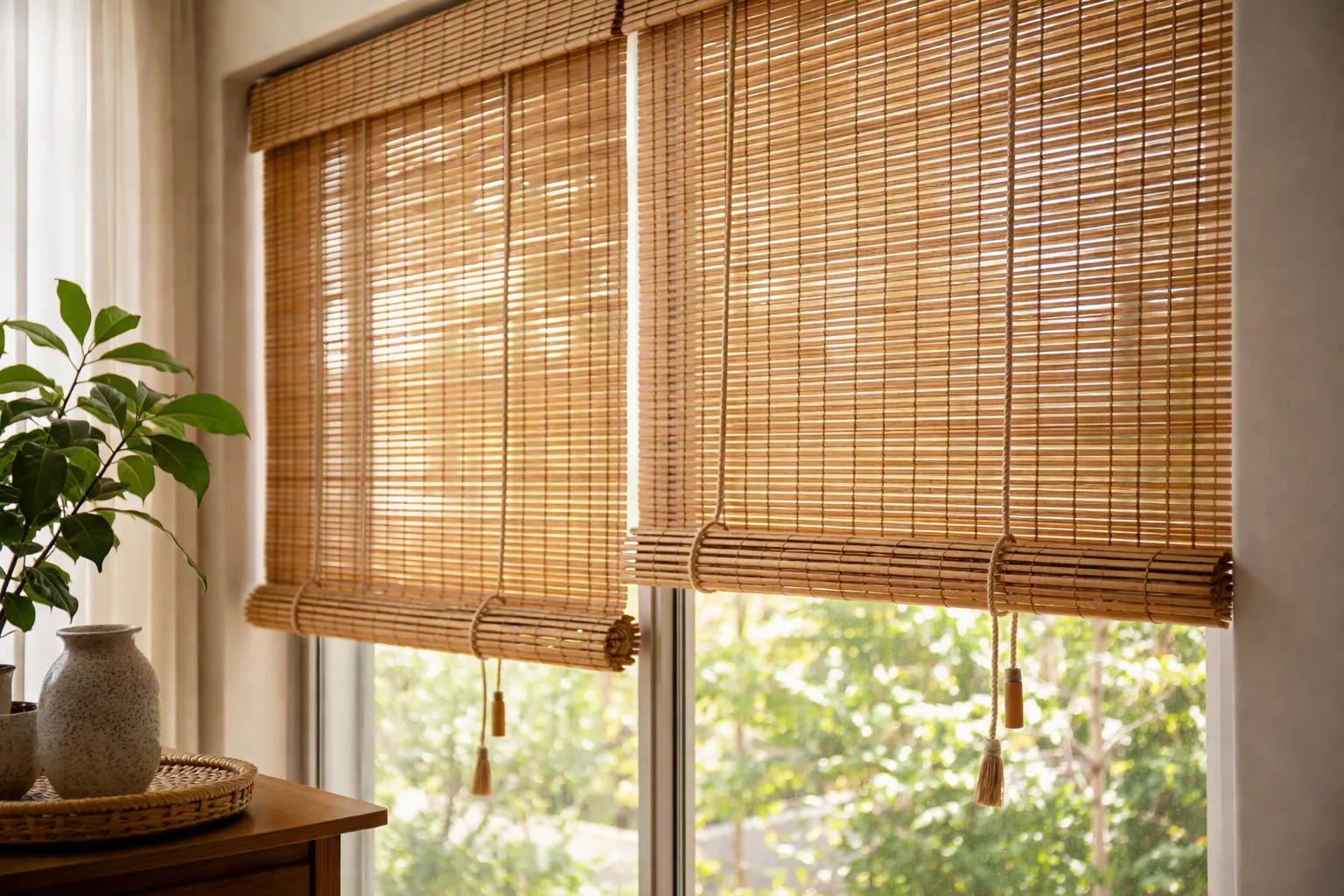

To install bamboo blinds, decide on an inside or outside mount, mark level bracket positions, pre-drill, screw the brackets into wood or proper wall anchors, then clip or slide the headrail into place and test the lift. A standard bamboo or woven-wood shade on a single, square window is a realistic DIY job for most people with a drill and a level. Wide windows, bays, heavy shades and anything motorized are where a professional install starts to make sense. Here’s the full process, plus the mistakes we see most often.
Quick Answer: How to Install Bamboo Blinds
- Choose your mount: inside the window frame for a clean look, or outside on the wall or trim for more coverage.
- Hold the headrail in position and mark each bracket location with a pencil.
- Check the marks with a level across the full width before drilling anything.
- Pre-drill pilot holes and fasten the brackets into wood framing, a stud, or wall anchors rated for the shade’s weight.
- Seat the headrail in the brackets (snap, slide or wing-nut, depending on the hardware).
- Test the lift, then install the cord cleat or tension device that came with the shade.
Tools You’ll Need
- Drill with a small bit for pilot holes and a screwdriver bit
- Steel tape measure and a pencil
- A level (a longer one is easier on wide windows)
- Stud finder, if you’re mounting on a wall
- Wall anchors suited to your wall (drywall, plaster or concrete)
- A sturdy step ladder, and ideally a second pair of hands for anything wide
Inside Mount or Outside Mount?
An inside mount sits within the window recess. It looks tidy and shows off the trim, but it needs enough depth for the headrail and enough clearance for crank handles and locks. Bamboo and other natural weaves always let a little light through at the edges on an inside mount, because the shade has to be slightly narrower than the opening to move freely.
An outside mount goes on the wall above the window or on the face of the trim. It hides a shallow or out-of-square frame, blocks more light at the sides, and makes a window look taller if you mount it higher. If you’re getting the size right before you order, our guide to measuring for inside and outside mounts walks through the numbers step by step.
How to Install Bamboo Shades Inside the Window Frame
- Mark the brackets. Place the brackets near each end of the headrail position, set back far enough that the shade clears the window hardware. Some shades have more than two brackets; space the middle ones evenly.
- Check level against the frame, not your eye. Window frames are often slightly out of level, especially in older homes. If the frame itself is off, split the difference so the shade doesn’t visibly tilt.
- Pre-drill and fasten. Drill pilot holes into the top of the frame and screw the brackets up through their top holes. Wood window frames hold screws well; if you hit a metal or vinyl window frame, stop and check what’s behind the drywall return.
- Hang the headrail. Most bamboo shades snap into box brackets or slide in and close with a bracket door. Push until you feel it seat fully, then give it a gentle downward tug.
- Test it. Lower and raise the shade fully a few times. It should move freely without rubbing the frame on either side.
How to Hang Bamboo Shades Outside Mount
- Decide the height. Mounting a few inches above the frame is common; going higher makes the window look taller and hides more of the shade’s stack when it’s raised.
- Centre the shade over the window so it overlaps the frame evenly on both sides, then mark bracket positions through the slots or holes in the headrail.
- Find your anchoring. Use a stud finder first. Screwing into the header above the window or into trim is ideal. On bare drywall, use anchors rated for the load. A plastic plug on its own is not enough for a wide or heavy shade.
- Fasten and hang. Screw the brackets in, seat the headrail, and tighten any wing nuts or retaining clips so the shade can’t be lifted out by accident.
Hanging Roll-Up and Matchstick Blinds
Inexpensive roll-up bamboo and matchstick blinds often come without a headrail. Instead, they have loops or rings at the top that hang on cup hooks or screw eyes, and the shade rolls up from the bottom with a pair of cords. Space the hooks evenly, line them up with a level, and make sure each one bites into wood or a proper anchor. These blinds are light, but the load sits on small hooks, and a hook in drywall alone tends to pull out over time. Tie the lift cords off on a cleat mounted well out of reach of children once the shade is rolled to the height you want.
Can You Install Bamboo Blinds Without Drilling?
For light roll-up shades, yes, in some cases. Tension rods inside the frame and no-drill brackets that clamp onto the top of the window frame can hold a lightweight shade in a rental. Adhesive hooks only work for very light shades on smooth, clean surfaces, and they can fail in heat or humidity. Anything with a headrail, anything wide, and any shade that gets raised and lowered daily really needs screwed-in brackets. A no-drill install that falls down does more damage to the wall and trim than two small screw holes.
Common DIY Mistakes (and How to Avoid Them)
- Brackets slightly out of level. On a wide window, even a small tilt is visible in how the shade hangs and stacks. Check level across the whole width, not bracket by bracket.
- Relying on drywall alone. Outside-mount brackets need a stud, the window header, or anchors rated for the weight. Natural-weave shades are heavier than they look, and the load increases when the shade is pulled down.
- Ignoring window hardware. Crank handles, locks and alarm sensors can stop an inside-mount shade from dropping straight. Check clearance before you drill.
- Skipping the cord safety hardware. Canadian rules for corded window coverings are strict for good reason. Always install the tension device or cleat supplied, and keep loose cords out of reach of children and pets.
- Cutting the shade down. Woven shades can’t be trimmed like a vinyl blind; cutting usually leaves frayed edges and loose weave. Order the right size instead.
When to Call a Professional
A single, square window with a lightweight shade is a fine weekend job. We’d suggest professional installation for:
- Bay and angled windows, where brackets meet at angles and the margin for error is small. Our guide to custom blinds for arches, bays and odd-shaped windows explains why.
- Wide or heavy shades, which may need centre brackets and solid anchoring to avoid sagging or pulling loose.
- High windows over stairs or in two-storey rooms, where ladder work gets risky.
- Motorized shades. A plug-in or battery motor adds weight to the headrail, and hardwired motors need a licensed electrician.
- Plaster or concrete walls, which need the right drill bits and anchors.
- A whole-home order, where consistent heights and alignment from room to room make the finished result look intentional.
If you’re hiring someone, our checklist on getting your home ready for installation day helps the visit go smoothly.
Want the Natural Look Without the Trade-Offs?
Real bamboo looks beautiful, but it lets light and views through its gaps at night, and it can warp or fade in humid or sunny rooms. Many homeowners get the same warm look from a woven-texture fabric in a natural tone, which installs exactly like a standard roller blind and comes in light filtering or blackout. See our honest take on bamboo blinds alternatives for what we’d recommend room by room.
Frequently Asked Questions
How high should bamboo shades be hung above a window?
For an outside mount, a few inches above the frame is typical. Mounting higher makes the window look taller and keeps more of the raised shade above the glass. Just make sure the shade is still long enough to cover the window sill.
Do bamboo blinds need a valance?
Not necessarily. Many woven shades include a matching valance that hides the headrail and brackets, which looks cleaner on an outside mount. On an inside mount, a valance is mostly a style choice.
How do you install natural woven blinds on a vinyl or metal window frame?
Avoid screwing into the window frame itself. Mount the brackets into the wood or drywall return around the window with proper anchors, or switch to an outside mount on the wall or trim.
Can I install bamboo blinds on my own?
Yes, on a standard window with a lightweight shade. If the window is wide, angled, high up or the shade is motorized, a professional install avoids sagging, crooked shades and extra holes in the wall.
Not Sure If Your Window Is a Good DIY Candidate?
Tell us about your windows when you reach out and we’ll give you an honest answer on whether a self-install makes sense. Straightforward single windows are a reasonable DIY job; for bays, wide spans and motorized shades, it’s worth having our certified technicians handle the install. Every quote starts with free in-home measurement across Mississauga, Toronto and the GTA. Request your free quote.