
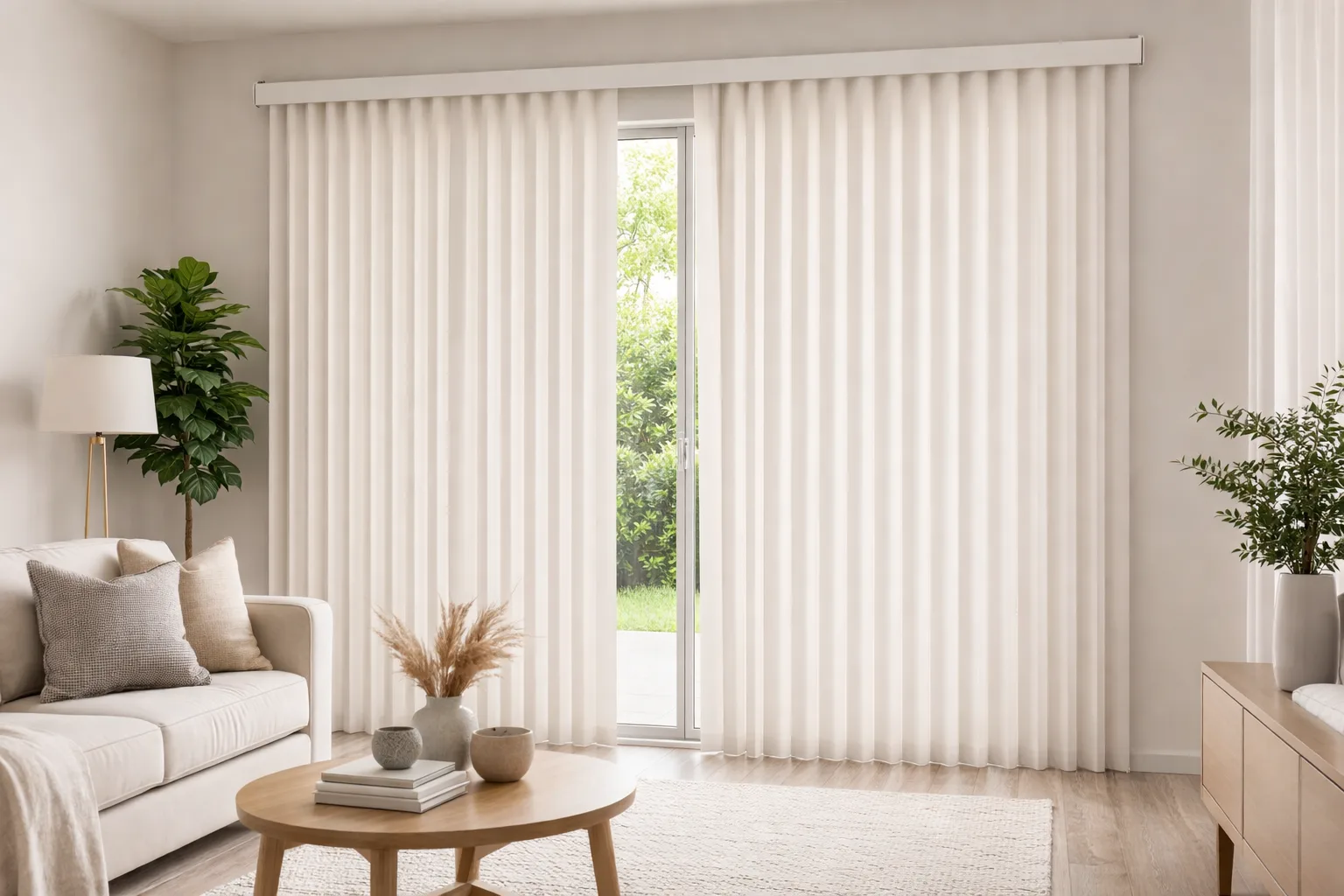

Vertical blinds are still one of the most practical choices for sliding doors because the vanes move in the same direction as the door, stack neatly to one side and leave the walkway clear. You can tilt the vanes to control light and privacy without opening the blind, then draw it fully back when you need to step outside. The details that decide whether they look and work well are the stack direction, the vane material and an accurate measurement, and that’s what this guide covers.
Why Vertical Blinds Suit Sliding Doors So Well
A sliding patio door is wide, it opens sideways and people walk through it many times a day. A horizontal shade has to be raised all the way to clear the opening, which puts a lot of weight on one mechanism and leaves a bulky stack at the top of the glass. Vertical blinds work with the door instead of against it.
- They open sideways, like the door. Draw the vanes back and the full opening is clear, with nothing hanging over your head.
- They tilt without opening. Rotating the vanes lets you cut glare or block a sightline while the blind stays drawn across the glass.
- They handle width well. Individual vanes hanging from one headrail cover a very wide span without the sag or weight of a single oversized shade.
- Damaged vanes can be replaced one at a time. On a busy door with kids and pets, that matters more than people expect.
Stack Direction: The Decision Most People Get Wrong
When a vertical blind is fully open, the vanes gather into a stack at one or both ends of the headrail. Where that stack sits changes how the door works every day, so it’s worth deciding before anything else.
One-way stack
For a standard two-panel sliding door, the stack usually goes on the side of the fixed panel, so the vanes never cover the part of the door you walk through. This is the most common setup for patio doors and walkouts.
Split (centre-open) stack
The vanes part in the middle and stack at both ends. It suits wide window walls and doors that open from the centre, and it gives a more symmetrical, drapery-like look in a living room.
Allow for stack space
Open vanes still take up width. On an outside mount, we usually extend the headrail past the frame on the stack side so the gathered vanes sit over the wall rather than over the glass. That way you keep the full view and the full doorway when the blind is open.
Choosing Vane Material for a Patio Door
The vane material affects the look, how easy the blind is to keep clean and how much light it blocks.
| Vane type | Best for | Worth knowing |
|---|---|---|
| Vinyl (PVC) | Kitchens, walkout basements, high-traffic doors | Durable and easy to wipe down; the most practical option for a door to the yard |
| Fabric | Living and dining rooms | Softer, warmer look; available in light filtering and blackout-backed versions |
| Textured or linen-look fabric | Open-concept main floors | Hides fingerprints and dust better than flat colours and looks less “office” |
Wider vanes give a cleaner line across a large door because there are fewer seams to catch the eye. Curved or overlapping vane profiles close more tightly, which helps with privacy and light at night. For help picking a shade that works with trim, floors and walls, see our guide to choosing vertical blind colour and texture that coordinates.
Walkout Basements and Doors to the Backyard
Walkout basements are one of the most common places for vertical blinds. The door is often the main light source for the whole level, it gets heavy traffic and it’s usually close to furniture. A vinyl or easy-clean fabric vane holds up well here, and a one-way stack toward the fixed panel keeps the path to the yard clear.
Basement doors also tend to be installed close to the ceiling or under a bulkhead, which leaves very little room above the frame. Checking that clearance during the measurement decides whether the headrail goes on the wall, inside the frame or on the ceiling.
Large Windows and Window Walls
Vertical blinds are not only for doors. Tall picture windows, window walls and wide sidelights all suit a vertical system, especially where a single horizontal shade would be very heavy or would need to be split into several pieces. A split stack with the vanes parting in the centre suits these windows well, and matching the vane colour to the adjacent patio door keeps an open-concept room looking consistent.
In Toronto and across the GTA, older condos and townhouses often already have a ceiling track or a pocket above the sliding door that was designed for vertical blinds. Reusing that position usually gives the neatest result. If you’re in the city, our custom blinds in Toronto page shows what else we install locally.
Motorized Vertical Blinds for Hard-to-Reach Doors
Patio doors often end up behind a dining table, a sectional or a kitchen island, which makes reaching a wand or chain awkward. A motorized vertical blind opens, closes and tilts the vanes from a remote or phone app, and it can run on a schedule, for example closing on a sunny afternoon to protect floors and furniture.
- Control options: remote, app, schedules and voice through Alexa or Google Assistant, with integration for systems such as SmartThings, Apple HomeKit and Z-Wave.
- Power: wired, battery or solar-powered motor options depending on where the door is and whether there’s an outlet nearby.
- Safety: no loose cords or chains near the floor, which is useful in homes with young kids and pets.
See our motorized blinds page for how the controls work.
Measuring and Mounting a Sliding Door Blind
Because the vanes hang from a headrail, small measuring errors show up as gaps at the sides or vanes that drag on the floor or the door track. A few points we check on every sliding door:
- Width at the top, middle and bottom, since door frames are rarely perfectly square.
- Height at both ends and in the centre, and whether the floor is level across the opening.
- Handle depth, so the vanes clear the door handle when they’re closed.
- Mount type: an outside mount on the wall or ceiling overlaps the frame and blocks light at the edges; an inside mount needs enough frame depth for the headrail.
- Stack side and control side, so the wand or motor is on the side you’ll actually reach.
Vertical Blinds vs. Other Options for Sliding Doors
Vertical blinds are the most practical all-round choice for a sliding door, but they’re not the only one. A wide roller blind gives a more minimal, contemporary look and disappears when raised, although you have to lift it every time you use the door. Zebra blinds offer a banded, modern style with adjustable light, but very wide doors may need to be split into two shades. If a clean single-fabric look matters most, our guide on how to choose roller blinds is a good place to compare.
Frequently Asked Questions
Are vertical blinds still a good choice for sliding doors?
Yes. They open in the same direction as the door, stack out of the way and let you control light by tilting the vanes. Modern fabric and textured vanes also look far less dated than the plain white vinyl many people remember.
Which side should vertical blinds open on a patio door?
In most cases, the vanes should stack on the side of the fixed panel, so they never cover the part of the door you walk through. Centre-open stacks suit wide window walls and doors that open from the middle.
Should vertical blinds be mounted inside or outside the frame?
For sliding doors, an outside mount is the usual choice. It overlaps the frame for better light control and privacy, and it lets the stack sit over the wall rather than the glass. An inside mount works only when the frame is deep enough for the headrail.
Can vertical blinds be motorized?
Yes. Motorized verticals can open, close and tilt from a remote, an app, a schedule or voice control, with wired, battery or solar-powered options.
Get Vertical Blinds Measured for Your Door
Browse vane styles and fabrics on our custom vertical blinds page. We offer free in-home measurement across Toronto, Mississauga and the rest of the GTA, and our technicians confirm the mount, stack direction and control side before anything is ordered. When you’re ready, request your free quote and tell us which doors and windows you’re covering.