
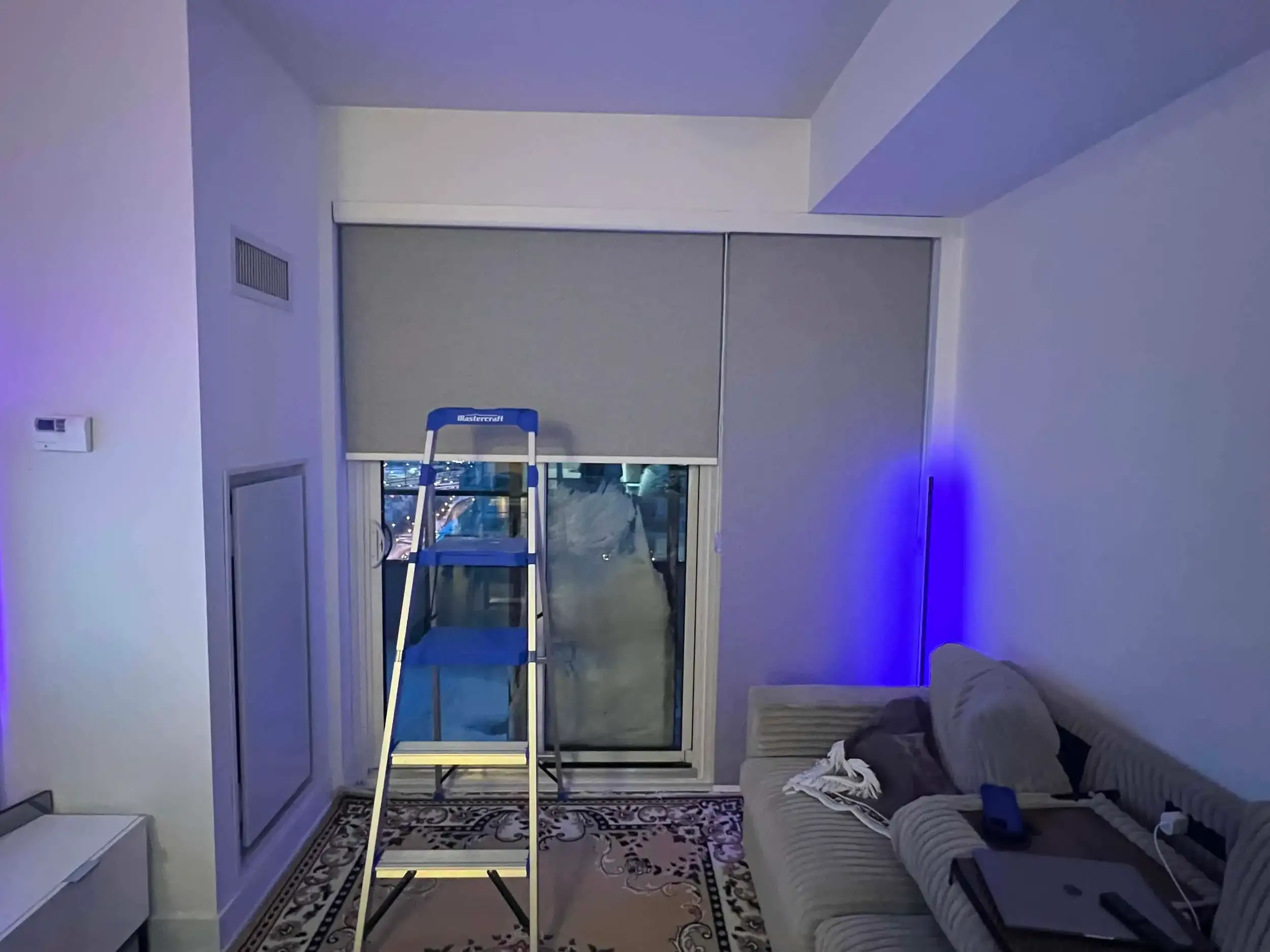

For most Toronto condos, the blinds that work best are roller or zebra blinds on the fixed floor-to-ceiling glass, vertical blinds or a wide roller on the balcony door, and a blackout or room-darkening fabric in the bedroom. What decides the details is your unit’s sun exposure, how the window wall is framed, and what your condo corporation allows on the side that faces the street. Here’s how to work through each of those before you order anything.
Start With Your Condo’s Window Covering Rules
Many Toronto condo corporations have rules about window coverings, usually to keep the building’s exterior looking uniform. The most common rule is that the side of the blind facing outside must be white, off-white or a specific neutral, and some buildings also restrict certain materials or ask that coverings be approved before installation. The rules live in the condo’s declaration and rules; your property management office can tell you exactly what applies.
Checking this first is the single most useful thing you can do. Coming back to replace blinds that don’t comply costs time and money, and it’s the most common oversight we see in condo installs. If your board only allows white on the exterior, many roller and zebra fabrics come with a neutral back or in light tones that suit the rule while still looking good from inside.
Floor-to-Ceiling Glass: Why Standard Blinds Struggle
Downtown and midtown towers are built with window walls: large glass panels separated by vertical mullions, often running from a low sill or the floor all the way up to a bulkhead. That creates a few problems standard, off-the-shelf blinds don’t handle well:
- Width and height. Wide, tall panels need a fabric and roller sized for the span so the blind hangs flat and doesn’t sag.
- Mounting surface. Blinds are usually mounted to the ceiling, the bulkhead or a concrete header. Knowing what’s behind the drywall matters, which is one reason condo installs are best measured in person.
- Reach. The top of a tall window is hard to reach, and a long cord or chain isn’t practical (or safe) on a window that size.
- Frames that vary. Even within the same building, panel sizes and bulkhead depths can differ from unit to unit, so a neighbour’s measurements won’t transfer to yours.
The usual solution is a separate blind per glass panel, lined up so the fabric bands and bottom rails sit at the same height across the whole wall. From inside it reads as one clean surface; from outside it keeps the uniform look boards want.
Which Blinds Suit Each Part of a Condo Unit
Living room and window wall
Roller blinds in a light-filtering fabric are the most popular choice for condo living rooms. They roll up almost out of sight, keep the skyline view when open, and soften the sun without making the room dim. If you want more control through the day, zebra blinds let you shift between sheer and solid bands, so you can keep some view in the afternoon and close them fully when the lights are on in the evening.
Bedroom
Bedrooms in a tower often face other towers, and city light doesn’t really switch off at night. A blackout roller blind (or a room-darkening zebra fabric) gives you both privacy and a darker room for sleeping. Mounting it outside the glass area, or close to the bulkhead with minimal side gaps, keeps light from leaking around the edges.
Balcony and sliding doors
Balcony doors are used constantly, so the covering has to stay out of the way. Vertical blinds are a practical fit because they stack to one side and you can walk through a partly open set. A roller blind works too if it’s mounted high enough to clear the door handle and track. We cover the options in more detail in our guide to vertical blinds for patio doors and large windows.
Den or home office
Screens and bright glass don’t mix. A light-filtering or zebra blind you can partly lower, so the top half of the window is covered while the lower part still lets light in, usually works better here than full blackout.
Sun Exposure: Match the Fabric to the Direction Your Unit Faces
A unit’s orientation changes what you need more than almost anything else:
- South and west-facing units get the most direct sun, and west-facing ones catch strong late-afternoon glare. A slightly denser light-filtering fabric, or a zebra blind, handles this better than a very sheer fabric.
- East-facing units get bright early morning light. Bedrooms here are the ones most likely to need blackout.
- North-facing units get softer, even light, so a lighter, more open fabric keeps the space bright.
- Higher floors tend to get more direct sun and reflected glare from neighbouring glass, since fewer buildings shade them.
If you’ve already got light-filtering blinds and the glare still gets through, the problem is usually the fabric’s openness or gaps at the edges rather than the blind type. Our article on why light filtering blinds still let in glare walks through the fixes.
Is Motorization Worth It in a Condo?
On tall window walls, often yes. Motorized blinds solve the reach problem, remove cords entirely, and let you raise or lower every panel on the wall together so they stay aligned. You can control them from an app, a remote or by voice with Alexa or Google Assistant, and set schedules so the blinds lower during the hottest part of the afternoon while you’re at work.
Battery and solar-powered motors are useful in condos because they don’t need new wiring through a concrete ceiling. You can see the options on our motorized blinds page. For a single small window you can easily reach, a cordless manual blind is usually all you need.
Blinds or Curtains for Condo Windows?
Curtains can soften a room full of glass and concrete, but in a smaller unit they take up floor space along the window wall and need a track mounted to the ceiling. Blinds sit tight to the glass and leave the floor clear, which is why most condo owners choose them for the main window wall. If you like the look of fabric, some people combine a roller blind for light control with a simple curtain on one side, purely for softness.
Frequently Asked Questions
What are the best blinds for condo floor-to-ceiling windows?
Roller and zebra blinds are the most common choices because they roll up compactly, suit wide glass panels and keep the view when open. Use one blind per glass panel, aligned across the wall, and consider motorization if the tops are hard to reach.
Can I choose any colour of blinds in a Toronto condo?
It depends on your building. Many condo corporations require the outside-facing side to be white or a light neutral, while the inside can be anything the fabric allows. Check your declaration and rules or ask property management before ordering.
Do condo blinds need to be cordless?
Canada’s rules on corded window coverings now limit accessible cords and loops on new blinds, so cordless and motorized options are the norm. On tall condo windows they’re also simply more practical, because there’s no long cord to manage.
Can blinds be installed without drilling into concrete?
Sometimes. It depends on whether the mounting surface is drywall over framing, a bulkhead or bare concrete. An in-person measure identifies the right mounting point and hardware, which is why we don’t recommend guessing from photos.
Get Condo Blinds Measured for Your Unit
Every tower is a little different, so the easiest way to get it right is a free in-home measurement. We’ll check your window wall, bulkheads and sun exposure, keep your building’s rules in mind, and give you a tailored quote with no hidden fees. You can read more about our work across the city on our blinds in Toronto page, or request your free quote and book a time that suits you.